Project Title: National Crude Oil Spill Fate and Natural Attenuation Research Site – Toxics
Project Number: 86070KC - MN 095
Project Chief: Erickson, Melinda
Project Start Date: 01-MAR-1983
Project End Date: Ongoing
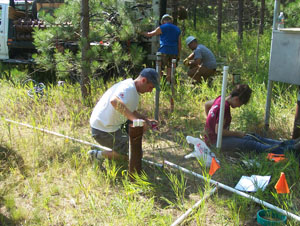
Jim and Bill driling water tube near 310 nest while Ean and Dina prepare to install water tube. Statement of Problem:
Many contamination problems result from the discharge and entrainment of liquid organic substances in ground water.
Major expenditures are being made to minimize or alleviate the impact of such contaminants on the environment but
detailed scientific understanding of processes in the subsurface is lacking. Spilled petroleum products are a major source
of ground-water contamination. About 10,000 barrels of crude petroleum spilled from a broken pipeline near Bemidji,
MN, on August 20, 1979. Although regulatory and remedial actions have been completed, as much as 4 feet of crude
petroleum is floating on the water table in the outwash aquifer. Ground water is dissolving the oil, and residual organic
compounds in the unsaturated zone are being leached downward.
Objectives:
The project’s primary objective is facilitating ongoing research at the site. FY 2010 research priorities are related to The FY2010 research priorities are organized into three components: unsaturated-zone, saturated-zone, and plume-scale research.
Relevance and Impact:
Research results and expertise developed at the Bemidji Toxics Substances crude-oil research site have benefited
Scientists and the public worldwide. Results have been transferred to many other sites of hydrocarbon contamination. The research team members receive numerous requests for information annually regarding research results from
people outside USGS. The Bemidji project also receives many requests for information regarding research results through
our web site. Through these contacts, research results and knowledge gained at the Bemidji Toxics site are transferred to
the public.
Progress during FY10
The field session had the largest number of researchers on-site in recent memory with over 35 in attendance. New research activities were conducted. The Minnesota drill rig crew supported this research effort by collecting over 70 saturated and unsaturated zone core sections, installing two vertical arrays of electrodes for monitoring biogeophysical activity, and installing four water tubes for monitoring subsurface temperatures. The MNWSC provided expert support for a synoptic sampling of BTEX. Several long-term data collection efforts were continued to support ongoing research into crude oil contamination in the subsurface. Continuous unsaturated zone and groundwater data was collected; including two sites with continuous unsaturated zone moisture, soil temperature, soil water pressure data, and seven sites with continuous water level data. Water levels and oil thicknesses were measured monthly in a subset of wells. An annual synoptic survey of water levels, oil thicknesses, and field parameters (pH, conductivity, dissolved oxygen, and temperature) was completed. Mindy Erickson presented a talk entitled, “Crude Oil at the Bemidji site: 25 Years of Monitoring, Modeling and Understanding” at the University of MN Water Resource Science Seminar on February 12. Jared Trost gave the same presentation to the MPCA remediation unit meeting on June 8.
Plans for FY 11
To support the ongoing research efforts for investigating and understanding sites of LNAPL contamination, the MN WSC will continue to coordinate field operations, maintain site infrastructure and equipment, host and update the project website, collect and manage field data, and operate the drill rig to suppoprt subsurface monitoring equipment installations and obtain sediment samples.
| 
 U.S. Department of the Interior |
U.S. Geological Survey
U.S. Department of the Interior |
U.S. Geological Survey